
Available 24 hours / 7 Days a Week
Email: info@senftlegal.com
Tort law is a specific legal system in the United States which offers justice and compensation for victims of civil injury, intentional or otherwise. Unlike criminal law, in which the state prosecutes the defendant for legal violations, in tort law, the victim may bring their own case against a person who caused them significant physical, financial, psychological, or emotional harm.
In the simplest of terms, tort law is just the system of law that deals with torts. What are torts, you ask? Excellent question—that’s just the place to start to learn more about tort law and how it works.
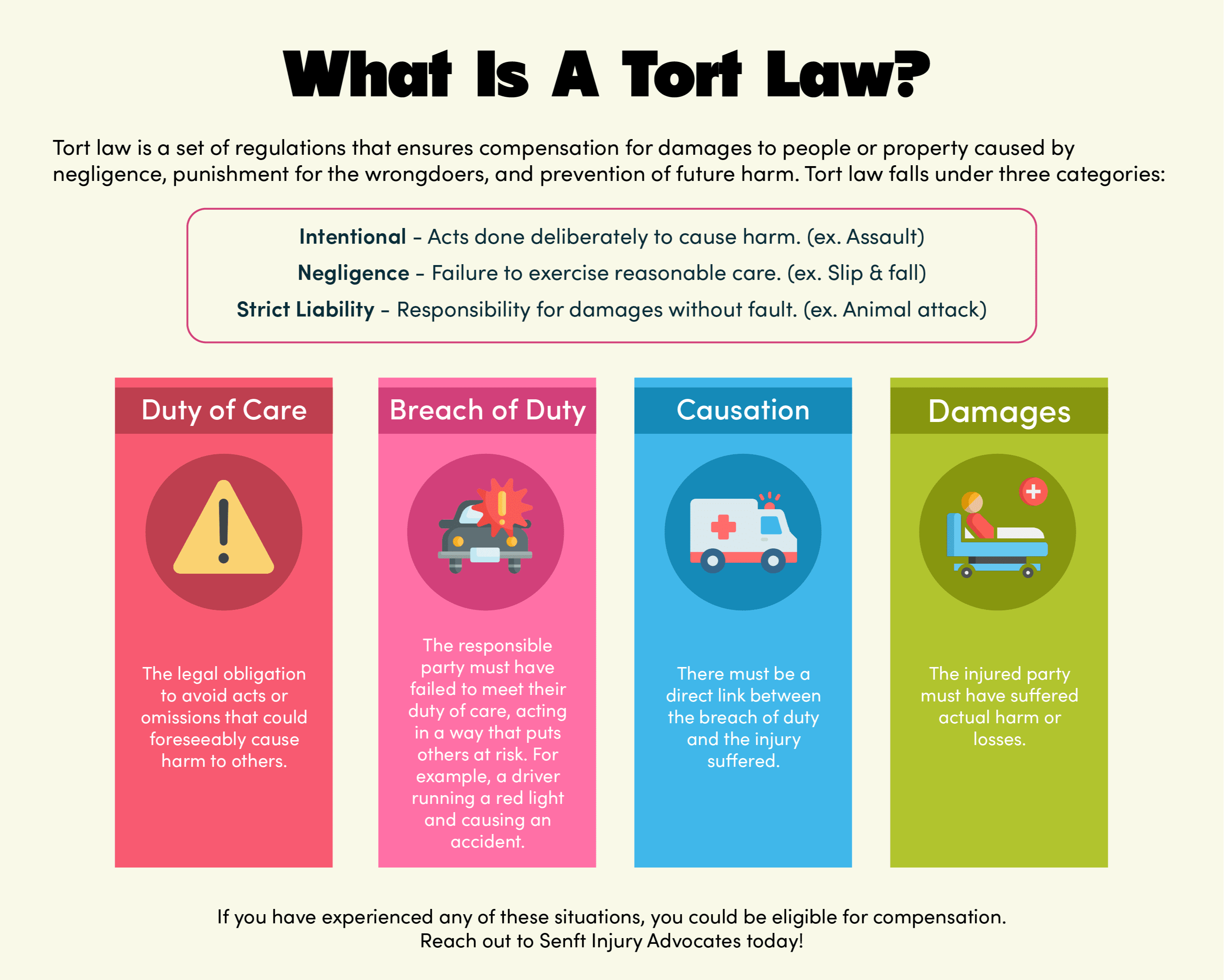
A tort is essentially an action that causes harm to another individual, warranting financial compensation for the victim. When someone carries out a tort against another person, tort law holds them responsible for paying for the damage. But how does the law determine which actions fall into this category?
The exact answer to this question can be a little complicated. Much of tort law is common law, based on precedents set by previous judicial decisions. This means that the exact boundaries of what falls under tort law are difficult to define and may vary from state to state.
However, you can generally define a tort by breaking it up into separate parts: the four elements of a tort.
The four elements of a tort are simply the four defining factors in an act of civil injury. Without all four of these elements present, the action likely cannot be compensated under tort law. The four elements of tort law are as follows:
Tort law falls under three categories: intentional torts, negligence torts, and strict liability torts. Let’s break down each of the different types of torts and what they represent. We’ll also present some examples of actions that fall underneath each of the types of tort law.
Intentional torts occur when a person deliberately engages in actions that cause injury or damage to another. To fall under this category, the perpetrator must have had intent to perform the act that led to the harm.
Examples of intentional torts include:
Negligence happens when a person fails to take reasonable care, resulting in damage or injury to another. It does not involve intentional harm, but rather a failure to act with the care the law expects of them.
Examples of negligence torts include:
Strict liability involves responsibility for damages, whether or not there was negligence or intent involved. In these cases, the law considers the act itself to be inherently dangerous. As such, the person taking this action assumes legal liability for any resulting damages, regardless of how careful they are.
Examples of strict liability torts include:
Compensation for tort victims is traditionally obtained through a civil court case. When a person suffers injury, property damage, or other loss, they may file a suit against the tortfeasor—the person who committed the harm. Upon hearing the case, the court then determines the amount of financial compensation the victim is entitled to, if any. However, in some cases, especially those involving liability insurance, compensation can be obtained without needing to go to trial.
For example, if you suffer injury after a car accident in Oregon (an at-fault state), compensation for your injuries is usually obtained through the other driver’s bodily injury liability insurance. If you can negotiate the full amount you are owed before filing a suit, it can be a faster and easier way to obtain compensation. However, insurance companies can take advantage of pretrial negotiations to try to lessen the amount they’ll have to pay you, potentially leaving you with less than the full compensation you need.
In order to avoid this outcome, you need a strong case backed by solid evidence, one that won’t break down in the face of intimidation from the other party. A seasoned tort lawyer can provide just the help you need, helping fortify and defend your case against these tactics. A lawyer’s insights can also help you investigate all potential avenues for compensation, maximizing the amount you can earn, and if pretrial negotiations reach an impasse, your attorney can also defend your case in court.
The purpose of tort law is to mitigate the dangers faced by everyday people and incentivize citizens to prioritize the safety of themselves and others. The primary function of tort law is to provide relief to those injured in acts of civil harm, known as torts, but it also promotes safety by imposing a penalty on those who cause harm.
Imagine someone (who we’ll call Sally) suffers a back injury during a car accident, a very common example of a tort. Sally’s injury has cost her a lot in medical bills, kept her out of work for several days, and will require several months of physical therapy to truly recover from. But the accident wasn’t her fault—she was hit by another driver who ran a red light.
Without tort law, Sally would likely have to suffer all these costs herself, even though she didn’t do anything wrong. Thanks to tort law, however, Sally has the option to pursue financial compensation through the at-fault driver’s insurance.
Because the person who caused the accident, known as the tortfeasor, is held financially responsible for the victim’s losses, tort law also serves as an effective deterrent against reckless or endangering behavior. A driver who knows he may have to pay for any damages he causes with his recklessness is more likely to check his blind spot before merging.
Tort law is distinct from criminal law in several ways. While torts and crimes are not mutually exclusive—someone can easily commit both at once—the two categories exist for different reasons, so the ways in which they are handled are quite different.
A tort case is carried out when the victim of an accident is seeking compensation after an accident. By contrast, instead of providing compensation for victims, criminal cases are specifically focused on maintaining justice and potentially administering punishment for criminal actions. Thus, criminal cases are carried out by the state, instead of by victims.
In some tort cases, the damages caused can be significantly greater than what the person responsible can pay for. Liability insurance, however, exists to help cover the cost if a person is found financially responsible in a tort-related case. Thus, insurance can play a pivotal role in tort law, particularly in cases involving auto accidents, as auto insurance is required in almost all U.S. states.
Yes. In rare cases, you can file a claim for compensation against a government agency under tort law. While personal injury cases typically fall under state jurisdiction, the Federal Tort Claims Act (FTCA) allows individuals to file claims against the U.S. government for injuries or damages caused by the negligence of federal employees or agencies.
However, there are notable limitations and requirements when it comes to tort claims against a federal entity, including the following:
You may first file an administrative claim with the appropriate federal agency that allegedly caused the harm through Standard Form 95. While not mandatory for filing a claim, it is recommended as it provides a clear outline of the necessary information to properly notify the agency of your claim.
You must file your claim within two years of the incident. If the agency denies the claim or fails to respond within six months of having received it, you may need to file a lawsuit in federal court to proceed.
Don’t hesitate to reach out to a personal injury attorney in your area to get more clarity about handling your unique tort case. At Senft Legal, we offer a 100% free consultation—absolutely no legal fees unless and until we recover your compensation. That means you can seek out legal assistance from a tort law professional without assuming financial risk. Don’t miss out on the recovery you deserve. Call 24/7 to reach an attorney and start your journey towards justice.