02/15/26
11 min
At-Fault vs. No-Fault States: Coverage, Claims, and Compensation

Table of Contents
Justice Simplified
At-Fault vs. No-Fault Insurance Systems: A Breakdown
Facing the stress of a car accident injury can be an overwhelming undertaking, especially when it comes to the potential cost from medical bills, vehicle repairs, and even missed days of work. The immense financial pressure of car accidents is one of the reasons car insurance is required in virtually every state, helping to relieve this burden. However, not all state insurance systems are equal, a fact perhaps made clearest by the divide between at fault and no-fault states. Understanding the intricacies of auto insurance policies in at-fault vs. no-fault states is crucial to knowing whose insurance pays, and what kinds of compensation you can expect.
What Is an At-Fault State?
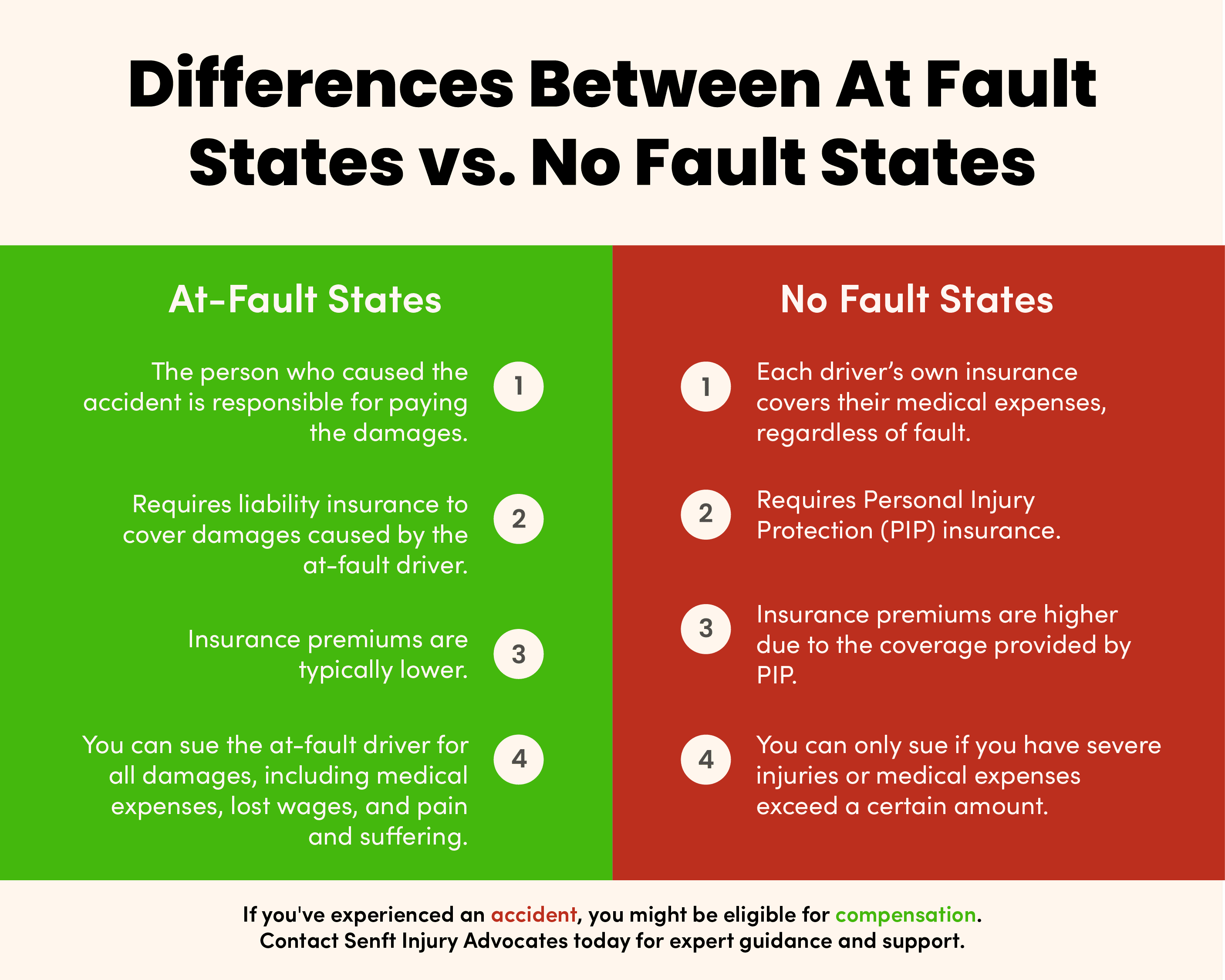
An at-fault state is essentially one in which fault the at-fault driver pays for damages. When an auto accident results in injury or damage to person or property, these states determine an at-fault party to assign financial responsibility.
38 states, as well as the District of Columbia, follow an at-fault system.
How Does Insurance Work in At-Fault States?
In order to ensure that an at-fault system can be upheld, these states require drivers to carry liability insurance. Since auto accident damages can easily outstrip what an at-fault driver might be able to pay out of their own pocket, liability insurance not only provides a critical safety net to financially responsible drivers, but also helps ensure that victims have access to financial recovery, one of the most basic fundamentals of insurance in the U.S.
How Do You Claim Compensation in At-Fault States?
When you’re injured in a car accident in an at-fault state, you can file a claim with the at-fault party’s insurance. Note that some insurance companies may be uncooperative or try to invalidate your case in order to reduce the amount they have to pay. An auto accident attorney can help you negotiate for the full amount you deserve, even taking the matter to court if necessary.
Deciphering Negligence: How Fault and Compensation Are Determined
Fault can be better understood through negligence, a critical concept of tort law. Negligence occurs when one party fails to uphold a duty of care—a legal expectation to avoid causing harm to another person—leading to injury. This may seem like a clear indicator of fault, but in many cases, multiple parties can be guilty of negligence. There are a few types of negligence systems in place to determine fault and compensation, which vary from state to state. Understanding the distinctions between these negligence systems is crucial. Here’s a quick breakdown:
- Pure Comparative Negligence. Every party involved in an accident can collect compensation, but the amount is reduced by their percentage of fault. For instance, if a person is found to be 10% at fault in an accident, they can still recover compensation. However, the amount would be reduced by 10%.
- Modified Comparative Negligence. This model is similar to pure comparative negligence, but with a key restriction. Parties can only recover compensation if their fault is below a certain percentage, typically 50% or 51%. This means a person who is more than 50% or 51% at fault (depending on the state) for an accident cannot recover any compensation from other at-fault parties.
- Contributory Negligence. Contributory negligence is one of the strictest forms of negligence law. If the injured party is found to be at all responsible for the accident, even just 1% at fault, they cannot recover any compensation.
What Is a No-Fault State?
A no fault state is one in which personal injury protection (PIP) insurance typically pays for injuries in a car accident. They’re called “no-fault” states because they bypass the need to determine an at-fault party before compensating a victim for their injuries, potentially allowing for faster recovery.
However, this does not mean that a person cannot be found at fault for an auto accident in a no fault state, nor that the at-fault party might not hold financial responsibility. The at-fault driver could still be held responsible for vehicle damage or pain and suffering, neither of which is typically covered by PIP insurance.
The following 12 states fall under a no fault system:
- Florida
- Hawaii
- Kansas
- Kentucky
- Massachusetts
- Michigan
- Minnesota
- New Jersey
- New York
- North Dakota
- Pennsylvania
- Utah
How Does Insurance Work in No-Fault States?
In no-fault states, drivers must have personal injury protection. PIP generally covers medical expenses, lost earnings, and other non-reimbursed costs, known as economic damages, regardless of fault. The exception to this is vehicle repairs, which are typically not covered.
In addition to PIP insurance, no fault states still usually require liability insurance, which means that premiums may be higher on average.
How Do You Claim Compensation in No-Fault States?
As a general rule, in no fault states your first source of compensation for car accident injuries and other economic damages is your own PIP insurance. However, you may be able to pursue further compensation from the at-fault party under certain circumstances. One example of additional compensation which some accident victims pursue is non-economic damages—losses that don’t have an inherent monetary value, such as pain and suffering, wrongful death, or reduced quality of life.
No-Fault States: Understanding Verbal and Monetary Thresholds
A person in an accident may still be able to file a claim against an at-fault party, even under a no-fault system. When the injuries suffered in a car accident are particularly severe, the limitation on seeking compensation from the at-fault party is lifted. No-fault auto insurance states use either a verbal or monetary threshold to determine exceptions for suing in auto accidents, affecting how damages and injury claims are managed.
- Verbal Thresholds. This system is in place in Florida, Michigan, New Jersey, New York, and Pennsylvania. It restricts lawsuits for non-economic damages unless injuries are deemed "serious", such as in cases of significant disfigurement or death. The definition of a "serious injury" can vary by state, but generally includes conditions like severe disfigurement, broken bones, or permanent loss of a vital bodily function.
- Monetary Thresholds. Hawaii, Kansas, Kentucky, Massachusetts, Minnesota, North Dakota, and Utah, use a monetary threshold to determine when the at-fault party can be sued for non-economic damages. This means a lawsuit for pain and suffering is only permitted if medical expenses exceed a certain dollar amount.
At-Fault vs. No-Fault States: Comparison
System | States Where It May Apply | Insurance Requirements | How Compensation Works |
|---|---|---|---|
At-Fault | Alabama, Alaska, Arizona, Arkansas, California, Colorado, Connecticut, Delaware, District of Columbia, Georgia, Idaho, Illinois, Indiana, Iowa, Kentucky*, Louisiana, Maine, Maryland, Mississippi, Missouri, Montana, Nebraska, Nevada, New Hampshire, New Jersey*, New Mexico, North Carolina, Ohio, Oklahoma, Oregon, Pennsylvania*, Rhode Island, South Carolina, South Dakota, Tennessee, Texas, Vermont, Virginia, Washington, West Virginia, Wisconsin, Wyoming | Liability insurance typically required, with varying minimums for damage caused to other persons and their property. Other types of insurance may or may not be required, depending on state legislation. Generally, this can result in lower required premiums, but it may lead to longer claims processes as it places more financial strain on insurers. | Damages are typically paid to the victim through the at-fault party’s liability insurance. This includes medical bills, lost wages, property damage, pain and suffering, and more. |
No-Fault | Florida, Hawaii, Kansas, Kentucky*, Massachusetts, Michigan, Minnesota, New Jersey*, New York, North Dakota, Pennsylvania*, Utah | Both liability insurance and personal injury protection are required. Other types of insurance may or may not be required, depending on state legislation. Generally, this can result in higher required premiums, but it can lead to simpler, shorter claim resolution for accident victims. | Compensation can come from different sources depending on the type and the severity of the accident. Economic damages for personal injury such as medical bills and lost wages can be obtained through your own PIP insurance. Further damages, such as property damage or pain and suffering, may be obtainable through the at-fault party’s liability insurance. Potential recovery may depend on whether injuries are deemed serious enough, depending on the state’s threshold. |
*"Choice" no-fault states, including Kentucky, New Jersey, and Pennsylvania, allow drivers to choose between an at fault or no-fault insurance policy, meaning both systems can be relevant in these states.
