02/05/26
12 min
Tort Law: A Comprehensive Guide by Senft Legal

Table of Contents
Justice Simplified
Tort law is a foundational aspect of the legal system, providing necessary recourse for victims of personal injury incidents. Despite its importance, tort law is not often discussed in the mainstream, making it more difficult for the average person to come to a more complete understanding. If you’ve recently suffered injury or property damage due to the actions of another person, it’s crucial to understand the basics of tort law, and how it can help you recover from your losses.
So, what is a tort system, exactly, how does it serve you, and what do you need to do to take advantage of it? This introductory guide will help you find the answers to these questions and more.
What Is Tort Law?
Tort law is the specific legal system in the United States which is designed to handle non-criminal acts of harm against others. These acts of harms are known as torts, which is where tort law gets its name.
What Is the Purpose of Tort Law?
The primary purpose of tort law is to provide relief to injured parties for harm caused by others by providing a way to obtain compensation for the damages suffered. Without tort law, those hit in a car accident, for example, might be forced to pay for their medical bills and vehicle repairs even if they were 0% at fault for the accident.
In short, the main functions of tort law are threefold:
- To provide adequate compensation for those suffering injury to person or property.
- To sufficiently penalize those guilty of torts for the harm caused.
- To discourage others from acting recklessly or causing willful harm.
All three of these functions help to mitigate the dangers faced by everyday people and incentivize citizens to prioritize the safety of themselves and others.
What Are the Elements of Tort Law?
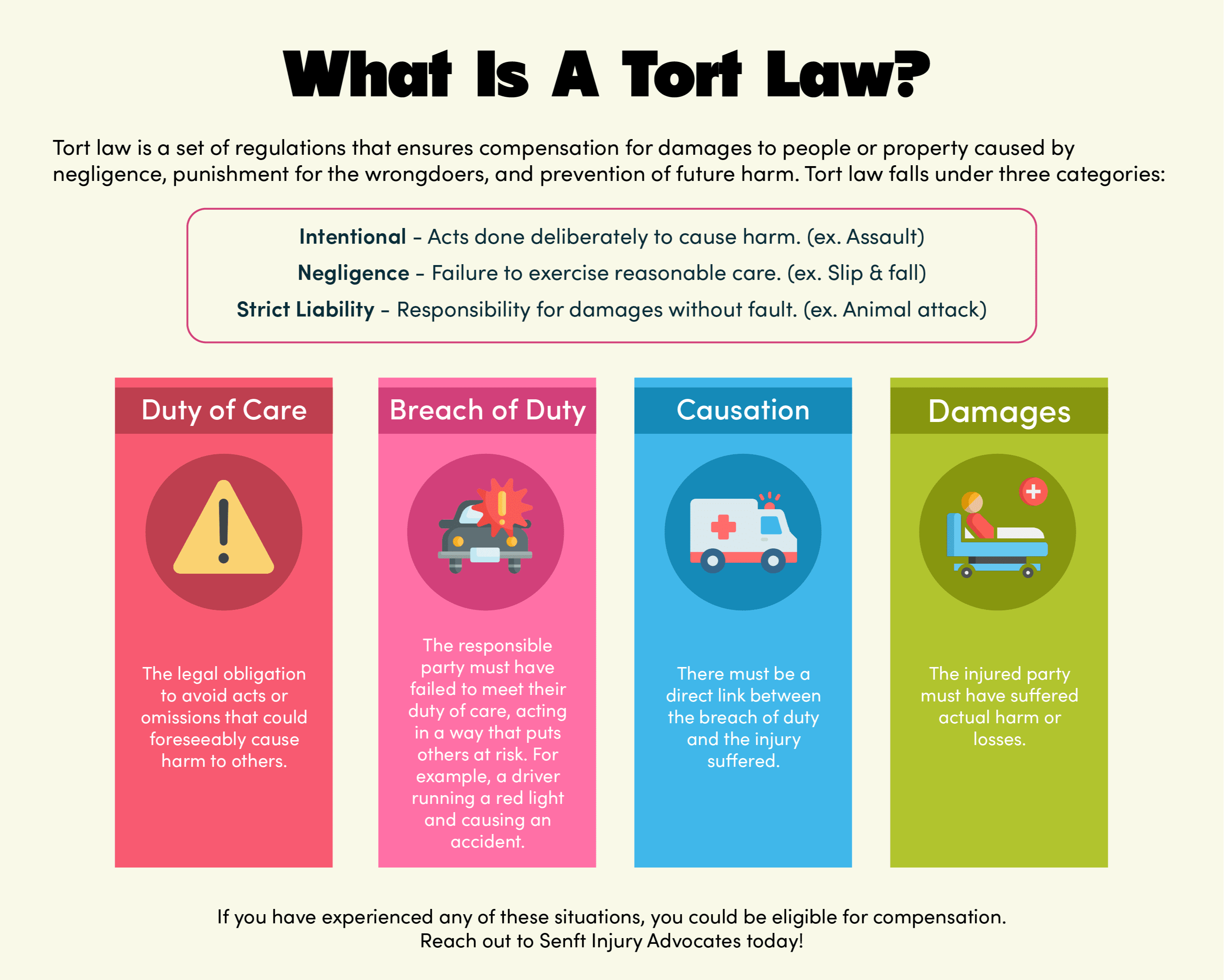
In most conceptions, tort law is made up of four main elements, which together make up a tort and may justify a civil case. These four elements are as follows:
- Duty. The element of duty in tort law refers to specific legal responsibilities a person may be subject to, known as a duty of care. A common example of a duty of care is that of motor vehicle operators—drivers are expected to drive safely and maintain awareness of their surroundings.
- Breach. This element refers to a failure of a person to perform their duty of care. If an automobile driver swerves onto a busy road without looking for oncoming traffic, this may be considered a breach of their duty of care.
- Causation. The element of causation can be an easy one to forget, but it is absolutely crucial to the operation of tort law. While many breaches of duty may be legal offenses in their own right, they do not justify a tort action on their own unless they cause harm to person or property. If our driver swerving into the road pulls directly in front of an approaching vehicle, resulting in a crash, then they have likely caused damage to said vehicle, and potentially the people inside.
- Damage. The last of the elements of tort law is damage, referring to the specific injury and property damage sustained by a victim of a tort. Naturally, this only includes damage specifically caused by the other party’s breach of duty. From our ongoing example, the victim of the car accident may be able to claim compensation for damages caused to the front of his vehicle by the at-fault driver, but likely not for preexisting scratches on the car’s rear bumper.
What Is the Difference Between Tort Cases and Criminal Cases?
Tort law is distinct from criminal law in several ways. While torts and crimes are not mutually exclusive—one can easily commit both at once—the two distinctions exist for different reasons, so the ways in which they are handled are quite different.
A tort case is carried out when the victim of an accident is seeking compensation after an accident. By contrast, instead of providing compensation for victims, criminal cases are specifically focused on maintaining justice and potentially administering punishment for criminal actions. Thus, criminal cases are carried out by the state, instead of by victims.
What Are the Different Types of Torts?
Tort law falls under three categories: intentional, negligence and strict liability. Let’s break down each of the different types of torts and what they represent. We’ll also present some examples of actions that fall underneath each of the types of tort law.
Intentional Torts
Intentional torts occur when a person deliberately engages in actions that cause injury or damage to another. To fall under this category, the perpetrator must have had intent to perform the act that led to the harm.
Examples of intentional torts include:
- Assault
- Battery
- Defamation
- False imprisonment
- Intentional infliction of emotional distress
Unintentional Torts
Negligence happens when a person fails to take reasonable care, resulting in damage or injury to another. It does not involve intentional harm, but rather a failure to act with the care the law expects of them.
Examples of unintentional torts include:
- Motor vehicle accidents
- Slip and fall accidents
- Medical malpractice
Strict Liability Torts
Strict liability involves responsibility for damages, whether or not there was negligence or intent involved. In these cases, the law considers the act itself to be inherently dangerous. As such, the person taking this action assumes legal liability for any resulting damages, regardless of how careful they are.
Examples of strict liability torts include:
- Manufacturing defects
- Animal attacks
What Does Insurance Have to Do With Tort Law?
In some tort cases, the damages caused can be significantly greater than what the person responsible can pay for. Liability insurance, however, exists to help cover the cost if a person is found financially responsible in a tort-related case. Thus, insurance can plays a pivotal role in tort law, particularly in cases involving auto accidents, as auto insurance is required in almost all U.S. states.
Can I File a Claim Against a Federal Agency?
While personal injury cases typically fall under state jurisdiction, it’s important to note that some cases may have federal implications. The Federal Tort Claims Act (FTCA) allows individuals to file claims against the U.S. government for injuries or damages caused by the negligence of federal employees or agencies. For instance, if an injury occurs due to negligence at a federally operated facility or by a federal agency’s employee, the injured party may have grounds to file a claim under the FTCA.
However, there are notable limitations and requirements when it comes to tort claims against a federal entity, including the following:
- Lawsuits under the FTCA are exclusively handled in federal courts.
- Punitive damages are not recoverable from these types of cases.
- You can only receive the amount specified in their initial claim unless new evidence is presented justifying a higher amount. For instance, if a person initially claims $50,000 in damages based on medical expenses and lost wages but later discovers additional long-term medical complications that weren’t initially apparent, they might be able to amend their claim to seek additional compensation if they can provide new evidence supporting the increase.
How Can I File a Claim Against a Federal Agency?
You may first file an administrative claim with the appropriate federal agency that allegedly caused the harm through Standard Form 95. While not mandatory for filing a claim, it is recommended as it provides a clear outline of the necessary information to properly notify the agency of your claim.
You must file your claim within two years of the incident. If the agency denies the claim or fails to respond within six months of having received it, you may need to file a lawsuit in federal court to proceed.
Seeking Compensation? How to Build a Strong Case
Tort law is a critical line of defense for victims of personal injury, but unfortunately, there are many obstacles you may face on the road to compensation. The good news is that you don’t have to face those challenges alone. A seasoned tort lawyer can help you avoid potential pitfalls and set yourself up for success, keeping your case on track and maximizing your potential compensation.
At Senft Legal, we understand that if you’re facing the consequences of a tort action, the last thing you need is added stress. That’s why we take care of the heavy lifting, leaving you room to rest and recover. Moreover, in order to allow you to secure compensation without taking on financial risk, we offer a free consultation and a no-win, no-fee policy. With Senft Legal, you can gain a knowledgeable and compassionate partner in your journey toward justice and recovery. So don’t hesitate to call a lawyer today!
Sources
- “Administrative Claims Under Federal Tort Claims Act” 40 CFR 10. https://www.ecfr.gov/current/title-40/chapter-I/subchapter-A/part-10.
- Baime, Eric. “Fundamentals of Tort Law.” National Juris University, National Paralegal College, www.nationalparalegal.edu/FundamentalsTortLaw.aspx.
- Kuersten, Andreas. "Introduction to Tort Law." Congress.gov, Library of Congress, 22 January 2026, https://www.congress.gov/crs-product/IF11291.
- “What Is Tort Law?” Institute for Legal Reform, U.S. Chamber of Commerce, 5 Oct. 2025, instituteforlegalreform.com/blog/what-is-tort-law/.
